
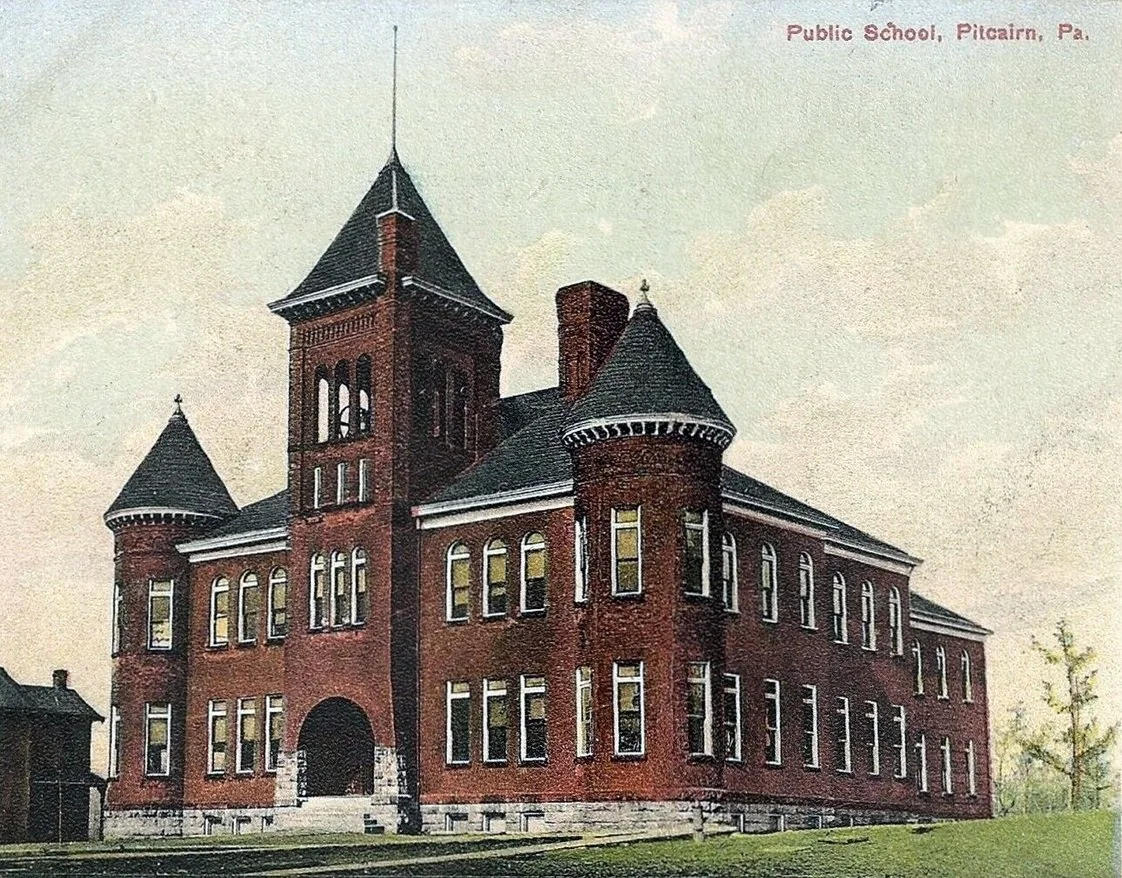
The Story of the Pitcairn Schoolhouse
The history of any community cannot be recorded without mention of its school system. For those who have lived in Pitcairn long enough, a stroll down 6th Street passed the current Schoolhouse might trigger fond memories of Pitcairn 1 and the familiar sounds of the bell ringing in the Bell Tower. How many of us still remember walking to school as the bell rang throughout the community indicating the start of yet another school day?
During 1890 and 1891, and for years prior, children from Walurba, then a village in Patton Township attended the old Brinton School on Haymaker Road, about a mile east of town near the present-day Haymaker Village Shops. As the village grew, this arrangement became increasingly impractical. In the fall of 1891, a private school was established in the back room of the old United Brethren Church on Brinton Avenue. Pupils paid two dollars per month and were required to furnish their own books.
In 1892, a four-room, two-story schoolhouse was erected on Eighth Street, on the site now occupied by the Pitcairn Italian Club. The two lower rooms were completed in time for the 1892 school term, and the school opened with one room in use. During the summer of 1893, the two upper rooms were finished in time for the fall term, allowing three rooms to be used. Approximately 180 students attended the school that year. By the fall of 1894, all four rooms were in full use. Continued enrollment growth required additional space, and by the fall of 1895 a fifth classroom was secured in the old United Presbyterian Church at the corner of Highland Avenue and Third Street.
The rapid expansion of the Pennsylvania Railroad’s massive transfer yards soon transformed Walurba into a booming industrial community. The yards required a workforce approaching 2000 employees, drawing both local residents and new immigrants to the area. This population surge created an urgent need for expanded educational facilities. Dissatisfaction with the administration of Patton Township further motivated residents to seek greater local control. With the support of the Pennsylvania Railroad, a charter was quickly granted, and on June 9, 1894, Walurba was incorporated as a borough. The new municipality adopted the name Pitcairn in honor of Robert Pitcairn, the visionary superintendent of the Pennsylvania Railroad.
One of the newly formed borough’s first priorities was the construction of modern public schools. When the first Pitcairn School Board met on July 25, 1894, it faced a significant challenge:. There were no taxes or other established means to finance education in the new borough. By securing funding through bonds issued by the Braddock National Bank, the board was able to finance the design and construction of what would be known as Pitcairn Public School Building #1. In 1895, the board hired the Pittsburgh architectural firm Boyd & Long to design the new school. During that era, Boyd & Long designed numerous schools, courthouses, and churches throughout Pennsylvania, Ohio, and Kentucky.
Construction began in the summer of 1895 at the intersection of Sixth Street and Highland Avenue. The building, later known as “Pitcairn 1” was completed and dedicated on February 22, 1896. Although designed for eight classrooms, six rooms were placed into service that fall, with the remaining two opening during the 1897 school year.
Built at a cost of $20,000 (approximately $800,000 in 2026 dollars), the two-story, eight-room, fire-resistant red brick structure was considered state-of-the-art in architecture, design, convenience, and durability. While most nearby one-room schools offered education only through the eighth grade, this impressive building provided instruction through the tenth grade. Before the opening of Pitcairn High School on Agatha Street in 1916, tenth-grade graduates of Pitcairn No. 1 often traveled to Turtle Creek or Wilkinsburg to complete their high school education.
In 1899, an annex was added to the rear of the school, containing two classrooms on the lower floor, further supporting education through the tenth grade. The second floor of the annex served for many years as a high school auditorium. The annex was demolished in 1987 and replaced with the borough’s maintenance garage, which was later demolished in 2019 to restore the site to a more period-correct appearance and to provide parking for visitors and workers.
The school was originally designed with a bell tower, but budget limitations prevented the purchase of a bell. In May 1896, a committee sought the assistance of Robert Pitcairn, superintendent of the Pittsburgh Division of the Pennsylvania Railroad and the borough’s namesake to fund the bell. Pitcairn agreed, and it was installed soon thereafter. More than 130 years later, that same bell remains in the tower, fully operational, its sentimental and heartfelt clang can still echo across the borough and into neighboring communities.
Following the construction of Pitcairn High School on Agatha Street, Pitcairn No. 1 was converted into an elementary school, serving grades one through six. After six decades in that role, declining student enrollment prompted the Gateway School District to reorganize and consolidate its schools in 1977. As a result, Pitcairn School No. 1, the district’s oldest building was closed after 80 years of service due to its age and the high cost of annual maintenance. In 1980, ownership of the building was transferred to the Borough of Pitcairn, where it continued to serve the community as the Borough Building. By 2018, continued deterioration of the structure prompted the Pitcairn Borough Council to vote to construct a new Borough Building on Broadway.
In 2020, Genesis Corp. purchased the historic schoolhouse with a vision to repurpose the beloved building as the home of the Pitcairn Historical Society Museum, an arts and culture center, and a space for community activities. The plan also includes the potential use of second-floor classrooms for small businesses to help financially sustain the building for years to come.
The Schoolhouse Advisory Board is currently working diligently to raise the funds necessary to bring this revitalization project to completion.